Will the NBA MVP ever win Most Improved Player in the same season?
The George Mikan Award typically goes to a young player who breaks out. It may be time to give it to established superstars who take their game to another level.

After a year where he carved his name next to the basketball elites, Philadelphia 76ers guard Tyrese Maxey was honored with the Most Improved Player award for the 2023-24 season.
It was a well-deserved accolade for Maxey who blossomed into a star, averaging 25.9 points, 3.7 rebounds and 6.2 assists per game. Maxey deservedly won the George Mikan Trophy which typically goes to a young player who made a leap in their career. In the 38-year history of the Most Improved Player Award, 29 of its recipients were 25 years old or younger.
However, what if voters took the award’s name literally and gave it to the MOST improved player instead of the best rising star? It can be easy to distinguish very good from decent but turning into a superstar from star is also an improvement that receives no recognition from the voting panel.
Toronto Raptors forward Pascal Siakam at age 24 took home the Mikan Trophy in 2019 after a scoring efficiency bump aided in increasing his points per game average from 7.3 to 16.9. That realization of offensive potential helped the Raptors win their first NBA championship that season. Siakam had transformed from a promising late first round pick into a legitimate starter. Not to downplay Siakam’s accomplishments but this is nothing new to the league. Meanwhile, Giannis Antetokounmpo became a megastar that same year with aspirations for the Hall of Fame.
Before Opening Night 2018, Antetokounmpo’s best per-game averages in a season were 26.9 points, 10.0 rebounds, 5.4 assists, and a .599 true shooting percentage. Those are the personal-best numbers taken from a five-year career. The Greek Freak topped all of those figures in 2018-19 alone.
Antetokounmpo became the first player in NBA history to average 27 points, 12 rebounds and five assists with a .600 true shooting percentage or better. This is not improvement. This is unprecedented ascension.
It is not just increased volume that make Antetokounmpo’s numbers look shiny as the efficiency metrics sing the same song. The Bucks forward raised his PER from 27.3 to 30.9, his win shares from 11.9 to 14.4 and his box plus/minus (BPM) from 6.2 to 10.4. Translation: He became an all-time great.
Notable players who finished ahead of Antetokounmpo in the voting include Siakam, De’Aaron Fox, Buddy Hield, and Montrezl Harrell.
Fox received votes on account of how awful he was as a rookie. Sure, Fox played like a functional starter in his sophomore season but there was nowhere to go up in terms of his production.
Fox’s teammate, Hield, eclipsed 20 points per game for the first time on .458/.427/.886 shooting splits. However, there was no stark difference between his play in 2018-19 and the season before. In fact, Hield’s total rebounding, assist and steal percentages declined. His successful play was in large part due to running hotter on increased volume shooting and playing time.
Harrell wrote a similar story where he was mostly the same type of player from an efficiency standpoint the year before but an uptick in counting stats for a playoff team garnered the attention of voters in this case.
Antetokounmpo was far and away the best player on the ballot but only received attention from the media in the form of one second-place vote and one third-place vote. Even if his overall improvement was marginal, the level of difficulty to reach unparalleled heights must be considered. The Bucks superstar went even higher than what was thought to be possible.
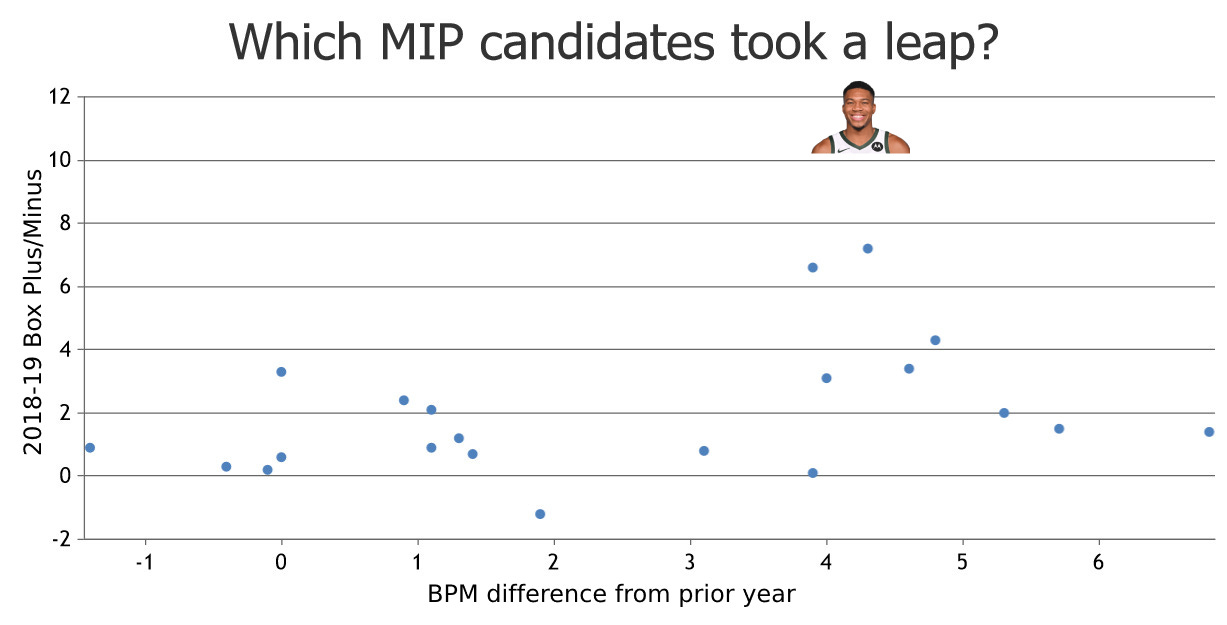
The chart above shows every player who received a vote for Most Improved Player in the 2018-19 season represented as a dot. Antetokounmpo’s dot is replaced with his headshot. The Y-axis indicates the player’s BPM for that year. BPM is a basketball box score-based metric that estimates a basketball player’s contribution to the team when that player is on the court, according to basketball-reference.com. A figure of 0.0 is defined as league average. +2.0 is a good starter. +4.0 is all-star level. +6.0 is an all-NBA season. +8.0 is MVP caliber. +10.0 is an all-time legendary year.
The X-axis is how much their BPM increased from 2017-18. This helps visualize which players took the biggest leaps from their counterparts. Three players actually performed worse in their “improved” year.
Antetokounmpo is on an island on the good side due to how he separated himself from his peers. The Bucks All-Star not only showed massive improvement but had a historically great season. His 10.4 BPM increased 4.2 points from 6.2 the year prior. Other players may have posted a larger difference in their BPM but most of them ultimately had fine years which is nothing out of the ordinary. The league sees high draft picks take a few years to develop and get going every year which was the case in 2018-19 with D’Angelo Russell, Fox, Hield, Sabonis and more.
The actual award winner, Siakam, put up a 2.4 BPM, an increase of 1.1 from the season before. His dot is in a cluster in the lower left region of the chart.
Award voters have bestowed MVP and Defensive Player of the Year to one player in the same year before (Michael Jordan, Hakeem Olajuwon, and Antetokounmpo). Surely, they can do the same with MVP and Most Improved Player which Antetokounmpo arguably should have received.
No player has ever won the award twice and there is no rule prohibiting that. Improvement is not binary, it is dynamic and if a hooper continues to elevate their game, why shouldn’t they be recognized again?
It is not often the league sees a once-in-a-generation talent emerge from seemingly nowhere. There is another Hall of Fame bound player who made significant strides to becoming an all-league talent but never won Most Improved Player despite vast progression year-to-year.
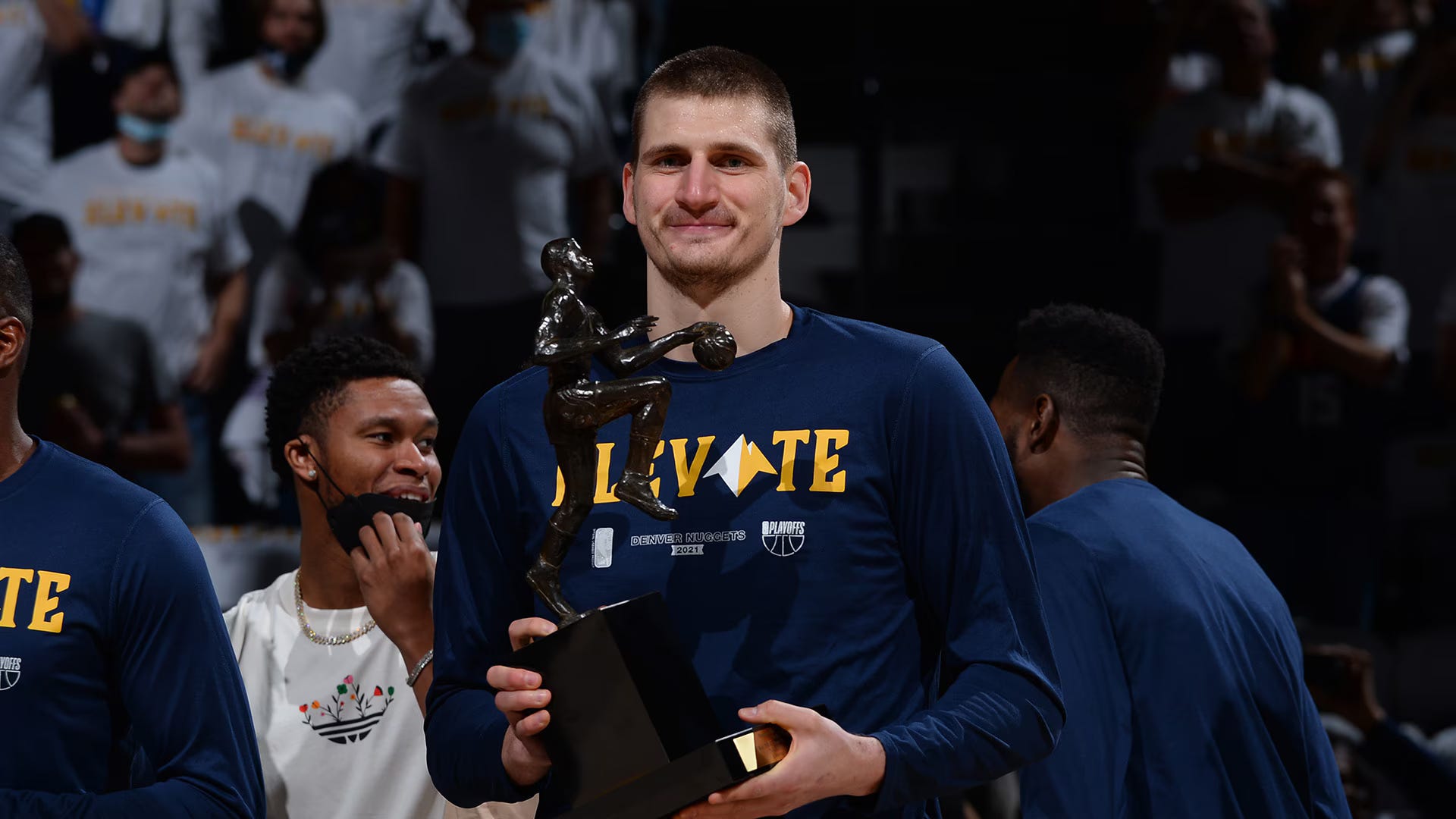
More recently in 2020-21, Nuggets center Nikola Jokic won the coveted Most Valuable Player trophy but did not receive a single vote for Most Improved Player despite raising his PER from 24.9 to 31.3 and BPM from 7.4 to 12.1. Like Antetokounmpo, this is when Jokic ascended to a Hall of Fame talent in his prime but does not get recognized for the improvement. The honor of the Mikan Award in 2020-21 went to Julius Randle who was largely the same player from the year before but shot an outrageous 41.1 percent from three. Randle never topped 35 percent again in his career, which spans 10 years to this point.
In Jokic’s case, how about righting the wrong and making him a serious threat to win his first Most Improved Player award in his sixth season? Before the Nuggets center won his first MVP, he finished ninth in voting the year before. A borderline top 10 player becoming the basketball player in the world in a span of 12 months is remarkable improvement.
Basketball fans have been blessed to see these international talents emerge when they were overlooked as prospects. It is rare to see hall of famers arise from these circumstances but if it happens again, the spirit of the Most Improved Player award should celebrate their unique ascension rather than a player in his early 20s showing competency.